
Recommended reading for every summer mood
On 20 books that feel inexplicably linked to the season

Regan’s newsletter publishes book recommendations on a theme and the occasional essay. Past newsletters have covered author completionism, reading routine, women in translation, and more.
Each season invites its own type of reading. Fall is for classics; winter, for the intimidating long ones; spring asks for short book to speed through and for trying something new.1 I save a certain kind of book until summer comes around (the books I know I’ll love, the books by favorite authors, the books I don’t think I’ll be able to stop thinking about until I’ve finished them), when I have the time and space to slow down and become entirely absorbed.
I’m the first to say it’s great to open a book by the window while the snow falls or near a fireplace when it’s cold outside, but now that we’re here, it’s hard not to pronounce summer to have the best reading conditions: a sunny early morning with the window open, reading before the day starts; somewhere outside in the evening, when the sun’s still up at 8pm. I can think of plenty of books I own that have sandy pages or chlorine pool-water splatters or covers greasy with sunscreen fingerprints.
I think of all the summers afternoons I spent dragging my mom’s floral comforter from college out of its home in the game closet to the flat grass of our front yard, where I’d lie in the sun and read after tennis practice. Or, I’d bike to the library for a stack of Sarah Dessen and Ally Condie to read while drifting on a blow-up pool float. I think of the many, many pages I read in the very back seat on those wonderful Montana roadtrips to visit family, mountains out the windows. I remember the specific sunburn I got reading The Handmaid’s Tale cover-to-cover on the back patio.
This summer, I’m reading with strawberries on a grassy hill in Central Park or an iced coffee on a quiet bench in the shade or on the evening train out of the city for a weekend away.
The books I’m recommending in this newsletter suit certain summer reading moods. With each recommendation, I’m including a second (and sometimes third) bonus title and letting you know what’s on my summer reading list that checks similar boxes!
Humid, strange, & intense books for when there’s a thunderstorm on the horizon
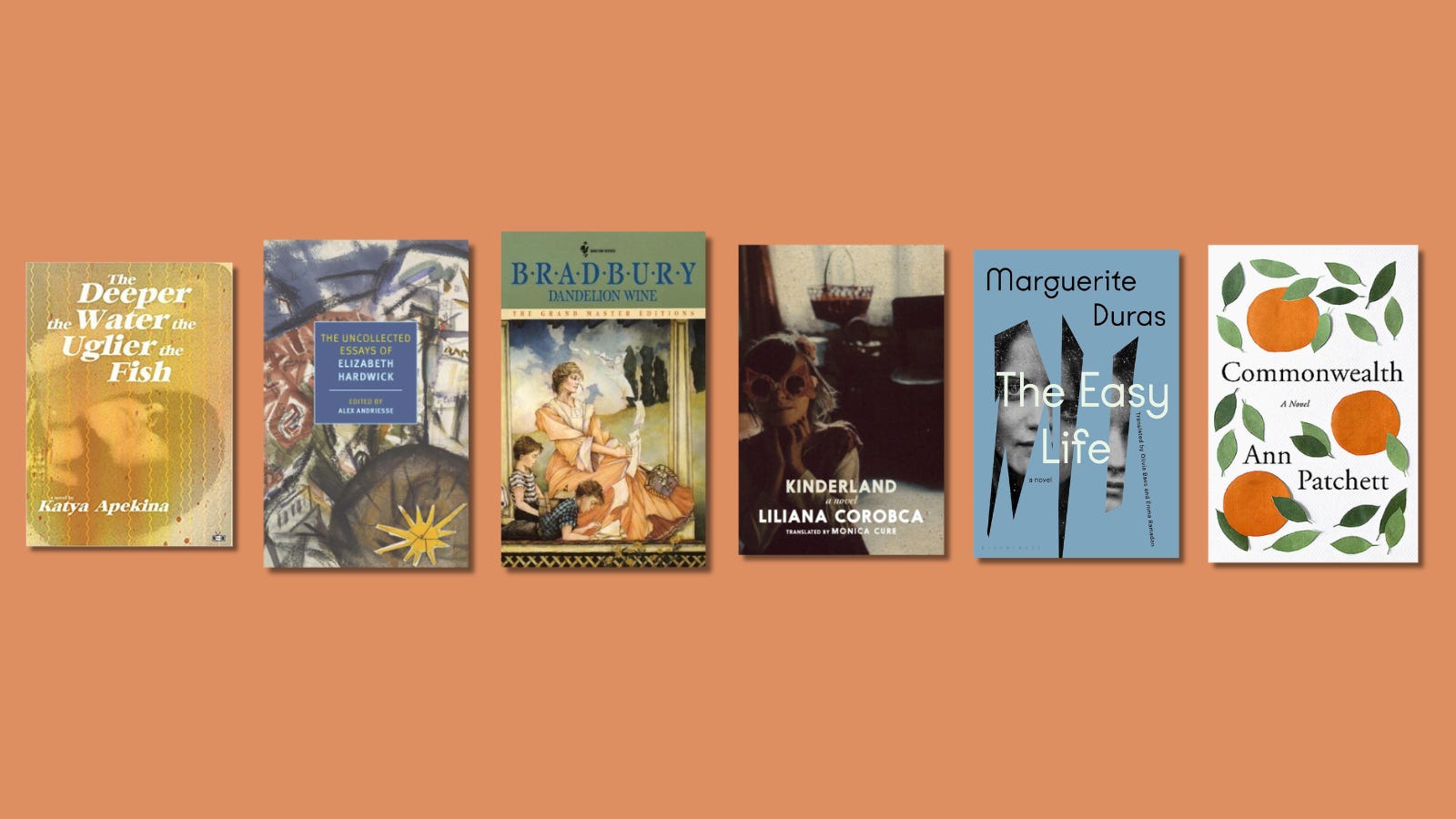
The Deeper the Water the Uglier the Fish by Katya Apekina (Two Dollar Radio, 2018)
Last week my lovely friend said she was looking for a book to read: something that’s easy to get into and fast-paced enough to get her out of her slump, and she’s always loved multiple perspectives. Texts about book recs are some of my favorites to receive, for obvious reasons, and I launched into a too-long voice note about Apekina’s debut (among a handful of others), which, in turn, prompted this very newsletter.2
I pitched The Deeper the Water the Uglier the Fish as an insane, depressing, obsessive novel that’s become a bit of an indie cult classic. It’s about two teen sisters whose mother attempts suicide, and they’re forced to leave their gothic Louisiana hometown for NYC to live with their father, a writer they hardly know. It’s a fragmented story that moves around in time and tone; there are alternating first-person accounts by the sisters, but also passages that jump back to the parents’ courtship and their activist pasts. It’s about art and mental health and what it means to be a muse, to desire a muse, and the consequences that arise from dependency! It’s about this tragic gulf that begins cracking open and widening between the two sisters, each finding themselves siding with one parent over the other.
This is a really dark story, but it’s stunning and poetic—it’s often very darkly funny, too. It’s a summer read in the sense that you’ll find yourself sinking into and quickly trapped by its dense, humid atmosphere. But Apekina’s debut is hardly a slog, it’s a novel that’s hard to put down. It’s almost impossible not to find yourself suddenly hurdling toward those final pages.
Two bonus novels…
Though a slightly quieter book, less overwhelmingly intense, Jessi Jezewska Stevens’ The Exhibition of Persephone Q (Picador, 2020) is another debut encapsulating that same heady, uncertain, slightly surreal summer city atmosphere. It’s unexpectedly witty in a similar way to Apekina’s novel, and darkly alienating. Also about art, intense relationships, art-making, having & being a muse, etc.
I have to mention Katya Apekina’s sophomore novel, too, which is similarly unhinged, although a lot more straightforwardly fun and hilarious in comparison to her first. In Mother Doll (Overlook Press, 2024), pregnant protagonist Zhenia finds herself communicating with her Russian great-grandmother, adrift in an amorphous cloud of ancestral grief that’s channeled through a celebrity pet psychic named Paul. Insanely good, insanely funny.
What’s on my summer reading list…
Permafrost by Eva Baltasar, trans. Julia Sanches (And Other Stories, 2018/2021) might sound like a cold-weather novel (ha, ha), but it’s described as a raw, intense first-person account of a woman breaking out of societal and familial expectations, “chasing escape wherever it can be found: love affairs, travel, thoughts of suicide” (according to the cover copy). I’ve been meaning to read Catalan author Eva Baltasar for ages, and when Martha Adams featured another novel from Baltasar’s trilogy in her Translated Summer Reading Guide (under the “Liminal Summer” category), I was reminded again that this would be a perfect little book to pick up soon.

Nonfiction that holds your attention like a good conversation in the park
The Uncollected Essays of Elizabeth Hardwick by Elizabeth Hardwick (NYRB Classics, 2022)
Reading Elizabeth Hardwick feels like learning from—and occasionally gossiping with—an incredibly articulate, intelligent friend or a candid, thought-provoking professor. I haven’t read her Collected Essays, and I haven’t read her renowned novel Sleepless Nights or short story collection The New York Stories, though all are on my list! I still loved this collection. I feel like I read once that someone said Hardwick was to New York what Didion was to California.3
I really admired her essays about reading (“On Reading the Writings of Women,” “Reading,” and “Southern Literature”), and there were so many other standouts: so much within the Feminine Principle section; in the Musings section, the piece about Leonardo daVinci’s inventions; “The Heart of the Seasons,” which is so beautifully about the effect summer has on beauty, time, aesthetics… ugh! It was interesting and refreshing, too, to read her thoughts on some more dramatic/political events of the 90s—the Kennedy scandals, Mendez brothers trials, OJ Simpson trial, Clinton/Lewinsky scandal, etc.—especially since the only perspective we’re getting on all of the above recently is Ryan Murphy’s, oof.
One bonus novel…
I love running in the summer! Lush green canopy overhead! Sweaty condensation on a blue Gatorade bottle from a post-run Duane Reade or Central Park cart! Prime people-watching: picnics and dog-walkers and the little hand-holding lines of five-year-olds in electric yellow vests on their way out to play. If I’m not jogging with a friend, I love listening to audiobooks, and audiobooks about running are always my first pick. Ben Ratliff’s Run the Song: Writing About Running About Listening (Graywolf Press, 2025) has some stellar moments and some less interesting ones, but I had fun listening to this professional music critic’s memoir on running as a new way of engaging with the music that makes up his life.
What’s on my summer reading list…
Whenever I come across Hanif Abdurraqib’s writing organically, I find myself so compelled by how he approaches and covers whatever topic he’s taking on. It’s a crime it’s taken me so long to read a full book of his, and I’m eager to finally pick up essay collection They Can’t Kill Us Until They Kill Us (Two Dollar Radio, 2017).
Nostalgic childhood classics for backyard reading in the sun
Dandelion Wine by Ray Bradbury (Bantam, 1957)
This is (and, I hope, will always be) one of my favorite books. I remember reading Bradbury’s The Martian Chronicles the winter I was fourteen, and then when summer came around, ordering a big box of old mass market Bradbury books off of eBay. I read them all, story collections mostly, but find myself returning to Dandelion Wine time and time again, picking it up off the shelf of my childhood bedroom every summer when I’m home in Minnesota for a week or two, skipping around to my favorite chapters.
The novel takes place in 1923, its narrator a 12-year-old boy named Douglas growing up in fictional Green Town, Illinois. Chapters are like short stories, each focusing on various residents of the town or Douglas’s adventures and misadventures. There are echoes of Bradbury’s speculative and supernatural fiction in some of the stories, all steeped in sweet—and bittersweet—childhood nostalgia. This whole book is the feeling of listening to the neighbors mow their lawn through your open bedroom window; running from backyard to backyard with your friends to make it home for dinner; having sleepovers; climbing trees and playing summer sports and going swimming in the lake; visiting your grandparents; looking forward to fireworks, then watching fireworks; but also feeling that still, quiet, almost-sadness in your stomach because things wouldn’t be this way forever, and then they weren’t, but sometimes they briefly are again.
One bonus novel…
I read a slim paperback of Tuck Everlasting by Natalie Babbitt (FSG, 1975) cover-to-cover on the dock at our cabin in Northern Minnesota the summer before moving away for college. Wise and whimsical, the novel is like a hot summer daydream or a fairy tale told around a campfire.
What’s on my summer reading list…
Everyone gushes about Ursula K. Le Guin and her children’s/young adult series Earthsea (and by everyone, I especially mean Laurel Clayton).4 I picked up a copy of the first novel, A Wizard of Earthsea (Clarion Books, 1968), at a used book store on a road trip through Tennessee last summer and am looking forward to finally diving into some fantasy.
Meditations on memory from around the globe, for dreamy, hazy reading at train stations and in secret gardens
Kinderland by Liliana Corobca, trans. Monica Cure (Seven Stories Press, 2013/2023)
This novel gives the feeling, somehow, of watching lazy midday light through the leaves make dancing shadows against your windows.
I first came across Moldovan novelist Liliana Corobca and translator Monica Cure when I read and loved their historical epic about WWII-era deportations in Eastern Europe, Too Great a Sky.5 I knew I had to read more by them both and jumped immediately into Kinderland, a gently funny, very sad, and very sweet contemporary novel about the children abandoned in a small Romanian village when their parents move across Europe for jobs so they can send money home. Our protagonist is just twelve years old and responsible for watching over her two younger brothers.
There’s one scene in particular where she describes a place that's special to her, a little island she visits every year, and it made me cry on the subway. Sharing just a taste with you here:
"The first time I discovered it, I was little, my parents were working in the vineyard and I went to look for walnuts. I went in and everything stopped, maybe I disappeared in that circle of earth. My parents noticed I was missing and they were looking for me everywhere, they got scared, where had their little girl disappeared to, and I was close to them, but I didn't hear anything and I was watching the clouds through the branches of the walnut tree. It was as if I had entered another world, as if I were practicing for heaven."
One bonus novel…
I reviewed The Scent of Light by Kristjana Gunnars (Coach House Books, 2022) for Necessary Fiction a few years ago6 when the Canada-based indie publishing house reissued her five short novellas as one complete book; they take place across Iceland, Canada, Germany, and Denmark.
What’s on my summer reading list…
I attended the final event on the book tour for The Summer My Mother Had Green Eyes by Tatiana Țîbuleac, trans. Monica Cure (Deep Vellum, 2017/2026) at Rizzoli Books just last night, and I simply can’t wait to fly through this one on a bench in the sun over the weekend. Written by an acclaimed Moldovan author, it’s about a Polish mother and son in France—and about the thin boundaries between hate and love and forgiveness. I’m a few pages in, and it’s already reading like poetry.
Translated classics by women writers about characters facing new challenges, or characters under pressure—for when the heat wave won’t break
The Easy Life by Marguerite Duras, tr. Emma Ramadan and Olivia Baes (Bloomsbury, 2022)
The Easy Life is Duras’s second novel, published when she was thirty and just recently translated into English, and I almost think I liked it more than her iconic The Lover, which she wrote at seventy and which has since become a classic. Slow, introspective, and violent—I think I appreciated that The Easy Life felt messier and less refined.
Kate Zambreno’s very personal foreword, “Everyone Says You Were Beautiful When You Were Young,” set a perfect stage for the novel that followed, about a twenty-five year old who leaves her rural family farm for the coast and soon finds herself unravelling in her small, dark hotel room, on the beach in the sand, caught on a psychological precipice after a tragic chain of events and feeling as if her life has passed her by.
“My life: a fruit I must have eaten some of without tasting it, without realizing it, distractedly. I am not responsible for this age or for this image. You recognize it. It must be mine. I am all right with that. I can’t do anything differently. I am that girl, there, once and for all and forever. I started to be her twenty-five years ago. I can’t even hold myself in my arms. I am bound to this waist I cannot encircle. My mouth, and the sound of my laugh, never will I know them. Yet I wish I could embrace the girl that I am and love her.”
One bonus novel…
Transit by Anna Seghers, trans. Margot Bettauer Dembo (NYRB Classics, 1944/2013) is a work of refugee fiction that follows a German man who, after having escaped the concentration camps, ends up in France, where he’s given a letter to deliver. The task brings him to waiting rooms, train stations, and government offices; the novel puts him up against endless bureaucracy and boredom (without ever being boring itself).
What’s on my summer reading list…
My friend from Greece gifted me Three Summers by Margarita Liberaki, trans. Karen Van Dyck (Viking, 1946/2021) after I visited her a couple summers ago, and like a terrible friend, I somehow still haven’t gotten around to it, however excited I’ve been to do so! This is another title that I’m feeling reminded to reach for after seeing it in Martha Adams’s Translated Summer Reading Guide (this time under the ‘Euro Summer’ category).
The best of summer book club fiction for the beach
Commonwealth by Ann Patchett (Harper, 2016)
Book club fiction and beach read both feel like loaded terms but what I mean are contemporary novels that hold! your! attention! There’s plot, maybe just enough romance, and compelling family drama; I don’t mean at all that they’re not literary, just that they don’t force me to over-exert myself to focus hard enough, pay enough attention. There are ready characters and themes that make me want to recommend the novel to friends (or yes my mom!) because there’s just so much to chat about.
Commonwealth is my favorite Patchett novel I’ve read so far. It’s about a family of step-siblings spending summers together in Virginia, and all that they get up to in childhood. And it’s about one of these girls who later, in her twenties, meets an older novelist with whom she begins a romance (an older novelist who then uses the story of her childhood and siblings as the basis of a bestselling novel). A book about love, grief, art, family etc. across fifty or so years, across tangled relationship, across the country. Ann Patchett at her best!! And due for a reread, I think.
One bonus novel…
Euphoria by Lily King (Grove Press, 2015) is another compelling summer page-turner. Unlike her more contemporary recent novels (which I’d also recommend), this one moves back in time to feature an anthropologist love triangle in 1930s Papua New Guinea… hot!
What’s on my summer reading list…
My friend Phoebe and I saw Ann Patchett speak at her Whistler (Harper, 2026) book launch in Brooklyn this week (ahh!!), and I’m as deep in my Patchett obsession as ever, currently craving black licorice, a treadmill desk, and a subscription to the Parnassus book club. I’m about 100 pages into Whistler and trying to slow down and savor it.7
Jung Yun’s 2021 novel O Beautiful is one of my favorites, and I’ve been anticipating her next book every since. I ran to pick up All the World Can Hold (37INK/S&S, 2026) when it came out just in time for my birthday in March, and I finally feel like I have the time to really sink in and enjoy it; the novel’s about three characters’ intertwining paths on a cruise ship post-9/11.
I would love to hear what books you’re looking forward to picking up this summer in the comments or over email :) & if you’re looking for a few more suggestions, here’s a link to three recommendations from summer 2024…
Summer Reading

Last week, the Great River Regional Library emailed to let me know my library card is about to expire. I’ll renew it when I’m home next month but hope they don’t give me a new card to replace the old. Made of thin, bright green plastic, it’s creased and torn and has been laminated over twice to hold it together. It’s like a time machine, because I can s…
Please let me know if you disagree, I’m curious to hear everyone’s takes!
Thanks Giovanna :)
Hoping this will tempt all you Didion die-hards

linked here if you’re interested! thanks Diane Josefowicz for assigning this one to me :,)

So many good bookish things to think about in your post—thank you! Firstly, so satisfying to this William Maxwell fan that you will read him. So Long See You Tomorrow for me is a wonderful novel. It meets the threshold of a taking a permanent place in the lit section of my memory. I remember specific scenes in detail though it’s been 10 years since I read it. Secondly, thanks for the Eve Balistar reminder. Can’t recall which substack book-lover inspired me to read Boulder, but Mammoth is now being ordered. I clicked through to Martha—when she says it’s the strangest novel she’s ever read, how can you pass it up? Permafrost will be next. Thirdly, Elizabeth Hardwick—novel or essays first?
Hi Regan, I think I stumbled upon you in one of Martha's posts recently and I'll share with you something similar I shared with her - I never tire of seeing these wonderfully refreshing, eclectic, different selections of books. Makes such a nice change from the same old books popping up everywhere, and sprawling TBR be damned, there's so many great books to be discovered.
Martha has already recommended I read Too Great a Sky but I'm now tempted to start with Kinderland. I've had Elizabeth Hardwick on my list for ages but I'm never sure with new authors whether to start with their fiction or essays. Similar with Lydia Davis and one or two others.
I have Transit on my shelf so that's a possibility for this summer as well - I read My Brilliant Friend with Kolina Cicero's read along last August and I was thinking of moving onto the next part. And from your post on last year's summer reads I spotted Kevin Wilson - I tried one of his books, I forget which, but couldn't get into it. He's been recommended by a few people because he might be a good comp for my own novel (it's hard finding recently published comps, which hardly bodes well for my prospects!), so I should probably persist. In my search for comps, I came across Richard Russo's Straight Man, which I've just finished (loved it) and totally unrelated was Javier Marias's A Heart So White, also just finished (brilliant).
Anyway, I'm rambling now, as I'm wont to do, inspiring post 🤗