

Regan’s newsletter publishes book recommendations on a theme and the occasional essay. Past newsletters have covered the 5+ Club and author completionism, the cure for autofiction, women in translation, and more.
I. The Encounter
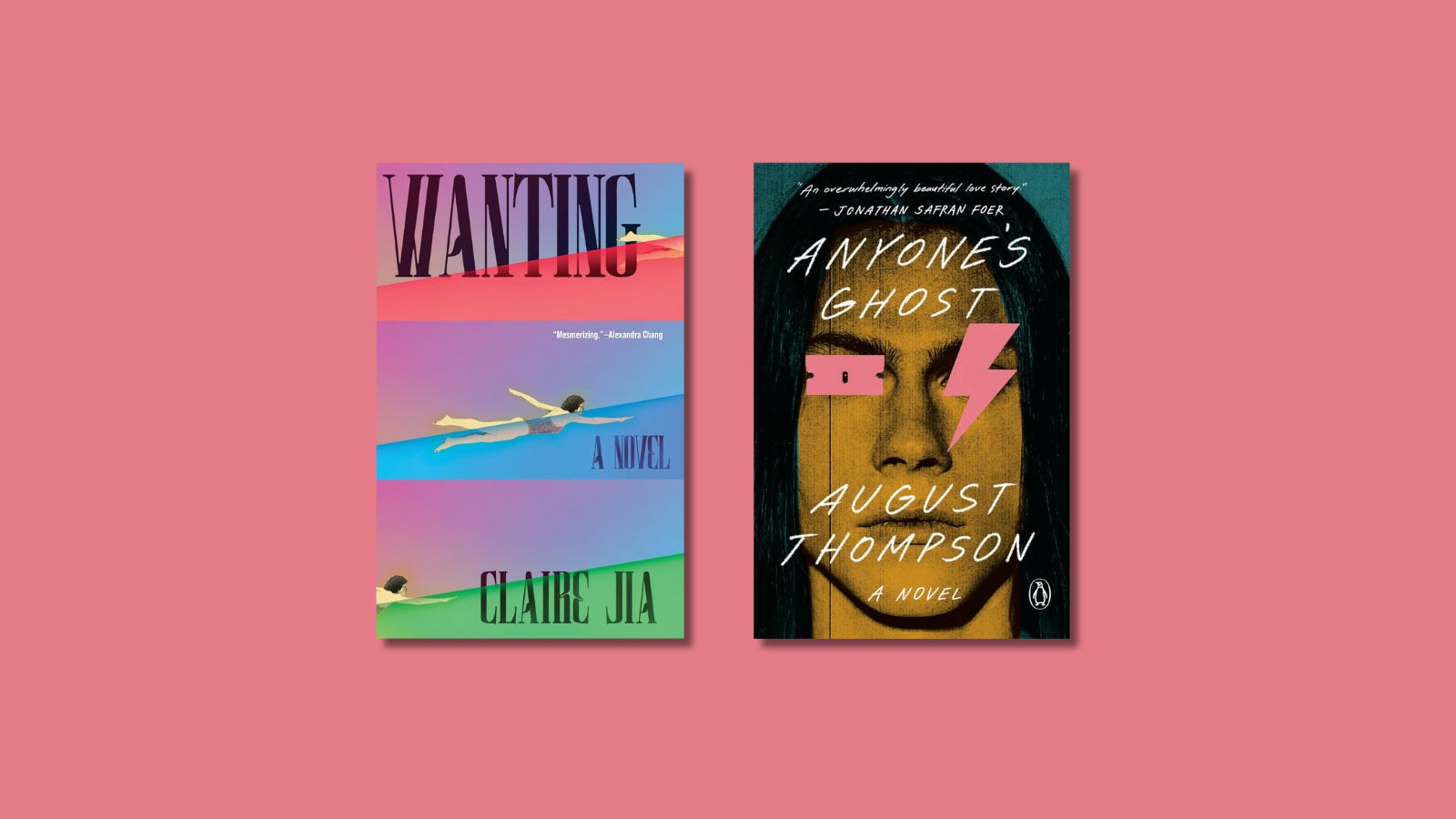
On back-to-back evenings this July, I found myself on the Strand’s fourth floor with friends to attend debut book events. For both, we’d booked our tickets weeks in advance. I first met Claire Jia at a friend of a friend’s book launch in the spring1 and eagerly awaited Wanting‘s pub date in the months that followed. August Thompson’s debut had been on my radar since it came out last summer; initially, it was its title, pulled from a song by The National, that caught my attention. A friend and I (she’s a wonderful musician, fellow National fan) saw that frontman Matt Berninger would be in conversation with Thompson at the Strand paperback release for Anyone’s Ghost, and we knew we’d have to be there.
Both evenings were full houses, authors and audiences lit by those classic Strand string lights across shelves of rare books. Claire, in conversation with writer Jenevieve Ting, spoke (among many, many topics) about the decade-long journey of writing and publishing her book, which had its origins as a political science thesis-turned-novel about US-China relations her senior year of college. August and Matt talked creative practice and showing up for one’s work: like planning to go for a swim, but maybe the pool’s too cold or you’re hesitant for this reason or that, but you get your swimsuit on anyway, make your way to the pool and dip your toes; some days—likely most days—you’ll end up wanting to jump in.
I hadn’t thought of the two authors—or the two novels—as in conversation with one another before attending, so I was surprised by how similar Claire Jia and August Thompson’s presences were before their audiences and how similarly they discussed their first novels, their characters’ eras-long friendships, and the complexities of sexuality and desire; both were so smart, funny, so wittily self-deprecating.
Before I get into what tied these novels together for me, a bit about each:
II. The Novels
Wanting by Claire Jia (Tin House, 2025)
Ye Lian has always wanted to move from Beijing to the United States. She’s never not been at the top of her class and loves learning English more than anything. As a fourth-grader, she’s serious, responsible, and mature for her age, but she surprises herself by covering for her classmate Lou Wenyu in a grocery store shoplifting bind (pockets full of candy), and the two become fast friends. Their connection, though, isn’t just a case of opposites attracting. For Lian, it’s a heart-thrumming instance of realization that she holds exciting, unknowable dimensions, that she’s more than an uptight, straight-A student.
In high school, Wenyu doesn’t care about homework or grades and lives instead for pulling pranks and time with her boyfriend. Still, she and Lian are always together. And then Lian doesn’t get into any of the colleges she applied to in the US. Wenyu, on the other hand, has let her grades fall low enough that she’s unable to take the Chinese university entrance exams. She’s sent to live with family friends in California, where she can finish the last year of high school and hopefully get into a state university. Little by little, the two girls fall out of contact.
Fast forward, and Lian works in a high position at a college prep company in Beijing. She tutors English. She plays badminton with her longtime boyfriend every Saturday. The two have a weekly dinner schedule so as to spend time with each set of parents. Wenyu, in the States, began vlogging during college and has become a full-fledged, California-fied influencer: Vivian, now, has dyed her hair blonde and takes lavish vacations with her All-American tech-bro boyfriend. They’ve just gotten engaged and plan to build a second gome in Beijing. Lian’s watched every vlog and knows every detail of Wenyu/Vivian’s new life—can you have a parasocial relationship with your childhood best friend?
When Wenyu returns to China, their friendship picks up as if the two had never lost touch—a girlhood honeymoon—but friendships and relationships are rarely as simple as we hope they might be !
While working on this newsletter, Henry Begler’s piece on Wharton’s Age of Innocence appeared in my inbox.2 The essay is amazing, about what the bourgeois realist novel actually is, and about the way time slips, the way our most inconsequential decisions in the moment sometimes become the very big ones. I couldn’t help but think of Wanting.
Claire Jia’s debut is set in contemporary Beijing rather than the 1870s New York of Newland Archer, but there are so many rigid expectations and social guises under which characters operate—whether these pressures emanate from parents, partners, bosses, peers, or our main characters themselves. This is a relationship novel, with intricate, shifting parts: affairs, secrets, schemes—a balancing act of what people are to one another and what they want to be. About who characters really are, and who they sometimes wish they were.
In that Wharton essay, Henry Begler writes:
Recently, though, I’ve been reading bourgeois domestic realism at a furious clip […] What changed is not that I got married (I didn’t) or that I live a comfortable bourgeois life […] but that I began, like anyone, to accumulate regrets and see roads not taken. I’m not that old or anything, in fact I would hazard a guess that I’m a bit younger than my median reader. But ten years in the adult world is enough time to begin to understand that as you age, certain doors close forever, certain choices that seemed trivial at the time are in fact meaningful and irrevocable, and certain chances that could have been taken, for better or for worse, were not. […] And I realize now that that’s what all these novels are actually about. The bourgeois realist novel is not really about how marriage is hard, how adultery is tempting, or how life in the suburban middle classes or in high society presents various obstacles to happiness. It’s about getting older.
And I feel we could copy and paste and apply that to this very novel—so I have :) There’s a beautiful flash-forward near Wanting’s conclusion that brought me to tender, wistful tears as I turned those final pages (not entirely unlike that which comes at the end of Wharton’s masterpiece).
Anyone’s Ghost by August Thompson (Penguin Press, 2024)
Theron is fifteen at the beginning of Anyone’s Ghost when he heads across the country to rural New Hampshire for a summer at his deadbeat dad’s. When Theron’s stash of weed brownies is discovered, his dad forces him into a summer job at a hardware store in town. There, he meets Jake: band t-shirt-wearing, seventeen-year-old, long-haired Jake is incredibly cool, much cooler than him. There’s a “let me take you under my wing” and “let me be taken” aspect to the relationship between them. The two swap music, get high, get drunk, go for long drives through the middle of nowhere.
The first sentence of the Anyone’s Ghost is “It took three car crashes to kill Jake.” And the novel jumps forward in time at the end of that summer, soon after the first accident.
Six years later, Jake visits Theron in New York City. He’s married and out of place with the pickup he drove up from where he’s settled in Texas. The tables have turned, kind of, in that the two are on Theron’s turf this time around. He’s grown up, grown out of his acne and awkward adolescence—but there isn’t a sense he’s grown into anything or anyone just yet. Theron’s mostly found his footing, has a kind-of girlfriend, Lou, and friends, and things to do. On Jake’s first night in town, the two are practically stranded together as a hurricane knocks out the city’s power and flash floods make roads and public transportation inaccessible.3
There’s a love story between the two men, but it’s a sharp-edged, bittersweet romance that ultimately paves a path for self-discovery and self-actualization. It brings Theron nearer to a sense of clarity he’s never possessed—who he is, what he wants, really, and who he wants—however much of an enigma Jake remains. This is a novel about mythologizing, longing, and transcendence; it’s equally about drinking and drugs and and the murky sense of not knowing what to do with one’s life as years speed by.
Anyone’s Ghost is a story steeped in grunge, angst, and the confusion of young-adulthood. What do our fifteen-year-old fantasies look like, and how could they surprise us or disappoint us or change us if (or when) they come true?
III. In Conversation
Wanting and Anyone’s Ghost are literary friendship novels propelled forward in suspenseful, thriller-adjacent frame. Both begin with a two-page prologue.4 In Wanting, police lights flash, caution tape unrolls, neighbors come outside to gossip and see what’s going on. Lian watches Wenyu talk to a paramedic as officers ask her about what happened. She stammers, “It was supposed to be a party.”
In Thompson’s first pages, an adult Theron rereads Jake’s obituary on his phone and searches for details about the crash from a Fort Worth Airbnb. He’s learned about Jake’s death through a DM from an old, arbitrary acquaintance. The funeral is tomorrow.
And from both of these set-ups, we drop back in time and move forward through the course of both relationships—first meetings and initial inseparability, some kleptomania, and then near-codependency. The long periods of distance, the reunions and re-discovery that follow. A closeness that occasionally orbits toxicity. Our main characters, Lian and Theron, are the ones who feel stuck and striving; their best friends, Wenyu and Jake, bold and carefree, seem to have everything figured out (they don’t).
It felt so correct that Claire Jia has worked as a television writer. Wanting is a novel of beats, scenes, explosive confrontations and layered conversations. It’s like I could imagine breaks between scenes as the pauses before your streaming service nudges you to play the next episode. There’s a new character who comes onto center stage about halfway through the book,5 and at first the pace slows a little here—I wondered about the bigger picture, felt suspended at a pivotal moment in Lian and Wenyu’s story—although it becomes so clear as pieces fall into place that Jia knew exactly what she was doing, what characters she was introducing and how and why, and the twists and turns she was taking readers on.
Thompson’s piece feels more mood and atmosphere-driven, though no less intense. We ruminate along with Theron about his insecurities in a deeply felt first-person POV—from cystic acne and purple growth-spurt stretch marks to his surfacing, uncertain bisexuality. The experience is less like watching a tv show than listening to an album cover-to-cover. There are swathes of the novel where not much happens—or, things happen, but slowly—yet tension wraps itself around and between characters: Theron and Jake, yes, but also Theron and his father, his father and Jake, Theron and, later, his girlfriend Lou.
Through everything, dialogue from both writers is a strength, natural and smart and often funny amid the tragic.
What I’m trying to get at is that I was surprised when what I thought were two very different novels about very different characters in very different circumstances felt like they were navigating such similar terrain. And so, especially after Henry Begler’s piece on Wharton, I found myself wondering whether the new bourgeois society novel for our time could be the intense, boundary-blurring coming-of-age friendship novel? Yes, these two debuts feature marriages and families, and they consider class and social expectation, but they do so by rotating around their tumultuous twin-star cores, tied with a bow of tragedy and suspense.
Honestly, I’m sure there are a hundred recent debuts that could fall under the subheading “about navigating desire & the intensity of friendship.” You might have been thinking, this whole newsletter, “Well doesn’t this also describe novels x and y and z?” Probably! I’d love to hear your recommendations of novels you think would fit well alongside Wanting and Anyone’s Ghost.
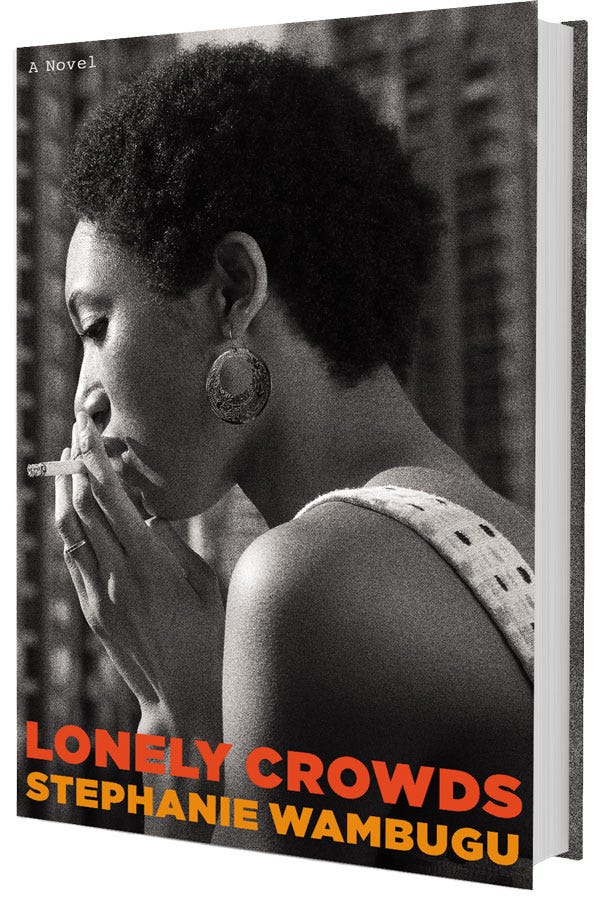
For one, I’ve been seeing so much recently about Stephanie Wambugu’s debut, Lonely Crowds, which came out in July. I haven’t read this yet but am eager to and feel like it would fit well in this newsletter write-up. Jasmine Vojdani’s Book Gossip newsletter on this one for The Cut is titled “Fraught Female Friendship, But Make It Queer: A mesmerizing novel explores the ambiguous space between friendship and romantic love.”6
IV. Quiz: Which to read first?
And for a little bit of fun, enjoy this silly quiz! And, most importantly, if and when you do end up reading either—let me know what you think.
Your dream day consists of…
a. A visit to the Funspot arcade, mini golf, and batting cages
b. Brunch then karaokeFor extra cash in high school, you…
a. Worked in family-owned, small-town shop
b. Held tutoring sessions over SkypeYour preferred playlist features…
a. Led Zeppelin and Metallica
b. Ed Sheeran’s “Shape of You”You’re going out for a movie night and choose to watch…
a. Inherent Vice at the Angelika
b. Mission: Impossible at the mall across the cityOn a Friday night, you can be found with friends at…
a. The same dingy downtown bar you’ve gone to since college
b. The buzzy new club brimming with influencersYour preferred romantic gesture is…
a. A thoughtfully curated mixtape
b. A private helicopter tourYou’re adopting a pet and take home…
a. Dr. Chips, an old brown-spotted Dalmatian
b. A very tiny, very photogenic Pomeranian
If you scored mostly a’s… grab a copy of Anyone’s Ghost
“A brash and well-turned coming-of-age tale. The arc of the story’s plot is largely tragic, but the mood is bighearted, revealing the power of the first flush of romantic and erotic connection.” —Kirkus
If you scored mostly b’s… pick up Wanting from your local bookstore or library
“This ambitious debut centered in contemporary Beijing delivers an engaging and insightful take on desire, envy, and betrayal.” —Kirkus
If you’re looking for more in the meantime…
LitHub has a recurring column that’s a favorite of mine, “5 Authors, 7 Questions, No Wrong Answers.” Here’s a link to Claire Jia’s, where she answers questions such as, If you could choose a career besides writing (irrespective of schooling requirements and/or talent) what would it be?
I’ve also always loved that the blog Largehearted Boy has authors share playlists for their novels. Here’s a link to August Thompson’s. He writes, “Anyone’s Ghost is very much a book about how the soundtrack of one’s life influences, and is influenced by, love. The main characters are, for much of the book, very young people, and as a once-very young person, I felt it was important to capture that feeling of being defined by one’s taste.”
Read Chyana Marie Sage’s memoir debut, Soft as Bones!
It felt special and coincidental to have read most of Anyone’s Ghost in my New York apartment with the windows open during a thunderstorm with record-breaking rainfall, after getting home the night of the book talk. Water cascaded from the building next to ours into their concrete courtyard like a waterfall into a pool.
Claire mentioned that the book didn’t sell on a first round of submissions despite positive feedback, but at the suggestion of an editor, she decided to include this very brief prologue and it just about instantly sold on next round
I don’t think it’s a spoiler to say he’s the middle-aged architect of the house Wenyu and her fiancé are building in Beijing
I also loved Wambugu’s conversation with Shy Watson for The Creative Independent
i feel very successfully sold on both of these books in this lovely post! the complexity of friendships as we age is truly an evergreen topic i can never get enough of.
the almost TOO obvious example is the neapolitan novels (how early childhood shapes the rest of our lives, class differences, ambition tears friendships apart and brings them together). more recently, my friends by hisham matar, which felt like it was about how we can build friendships up to be places to live in.
This is really smart! I love the feeling of when two books that you happen to read in succession seem to really be speaking to each other. I had that recently with LIARS and THE DRY SEASON -- even though they don't have much in common (one's a novel about a straight marriage, one's a memoir about a queer woman taking a dating hiatus), I felt that they both spoke in interesting ways to the state of contemporary relationships and had me questioning what purpose romantic relationships are serving in the modern world.
I think it's therefore interesting that the friendship novel seems to have superseded the relationship novel as the next iteration of the contemporary bourgeois realist novel. I feel like we're seeing a real shift towards people examining how platonic ties--which previously seemed at the margins, incidental to the real purpose of a person's life--can actually represent the central material of a person's emotional experience. Bonus points if it's a quasi-romantic friendship that neither party takes seriously as a relationship but that they seem to value more than almost anything else in their lives.